AN ECOPEDAGOGY IN AN ART SCHOOL
microsillons, 2024
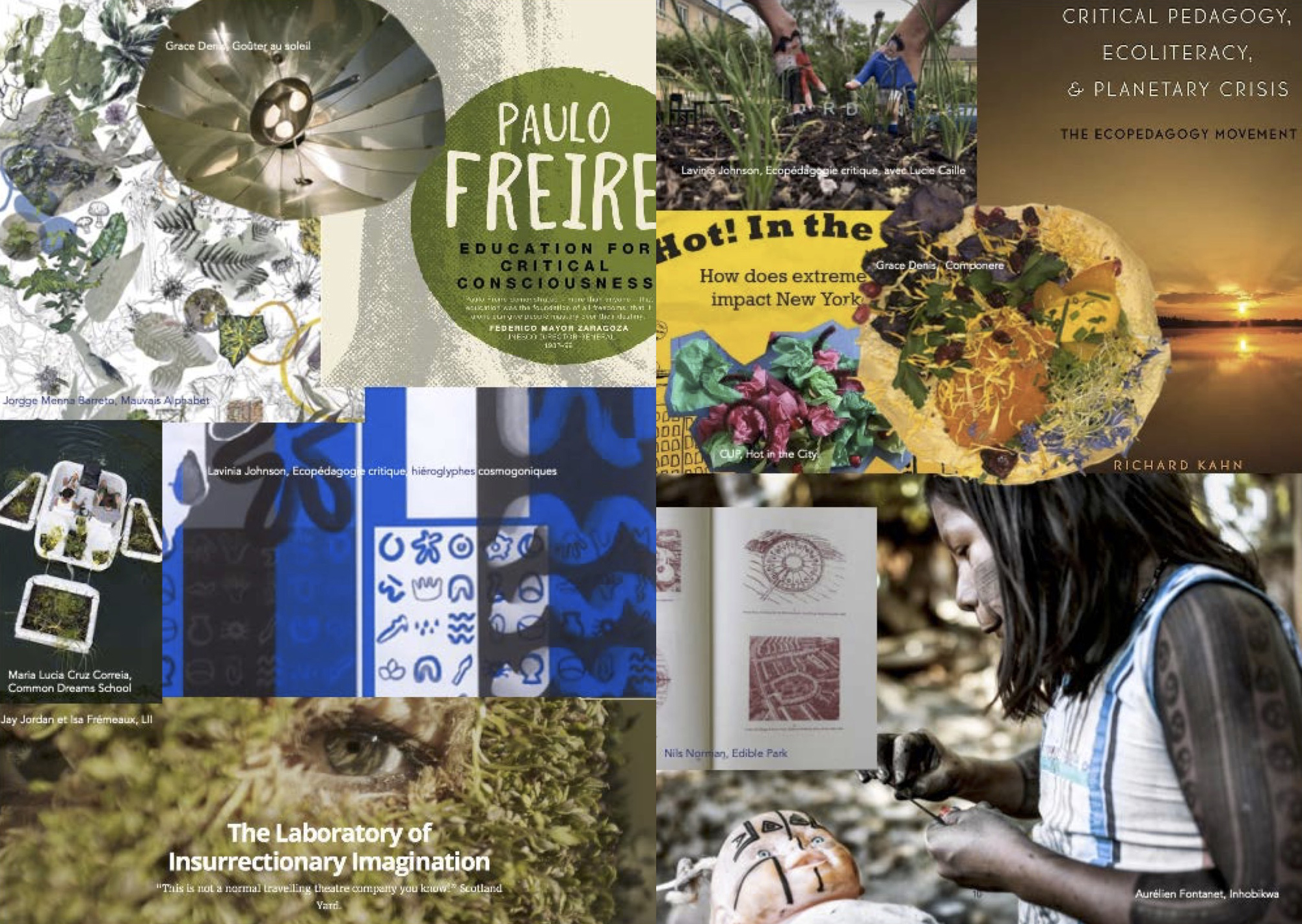
The text was initially published in the Journal En Marges !
microsillons (Desvoignes, Olivier & Guarino-Huet, Marianne) 2024, “Une écopédagogie dans une école d’art”. En Marges !, n°12.
INTRODUCTION
In matters of ecology, for our personal and local actions to have meaning, they must be articulated with a global perspective 1 . Ecopedagogy seeks to foster, through education, a planetary consciousness capable of challenging a Western way of life based on the exploitation of human and non-human beings, extractivism and the myth of perpetual growth.
If ecopedagogy can be considered a horizon for all educational approaches, it seems to resonate in a particularly meaningful way with art studies. Indeed, as we will see, several intellectuals have demonstrated the importance of taking into account the sensitive dimension in order to initiate genuine engagement in ecological struggles.
We work as microsillons2 , a collective that develops artistic projects in which cultural objects of different types (exhibitions, newspapers, posters, websites…) are co-created with groups of people who are not art specialists.
In 2015, we were engaged by the Geneva School of Art and Design (hereafter HEAD – Genève)3 — a school that provides training in visual arts and design (for example in graphic design, interior architecture or fashion).
Within this institution, we are responsible for the TRANS– Master’s programme in Socially Engaged Artistic Practices. This programme enables students to develop artistic practices that seek forms of social transformation through collaborative modes of production.
Within the framework of this master’s programme, we have experimented with different forms of exchange in order to implement such an ecopedagogy.
THE TRANS– MASTER’S PROGRAMME IN SOCIALLY ENGAGED ARTISTIC PRACTICES
The TRANS– Master’s Programme in Socially Engaged Artistic Practices is based on collective projects within which co-creation processes (between artists and people who do not define themselves as artists) are established in order to seek potential social transformations through art. These projects are conceived and produced by the students in dialogue with members of civil society4 . They are developed over the long term — meaning at least throughout the two years of the master’s programme. Students are responsible for inventing their own ways of collaborating, involving other people and developing their projects. We advocate for this collective learning process, in which self-management plays an important role.
ECOPEDAGOGY
Since the creation of microsillons in 2005, the writings of Brazilian critical pedagogue Paulo Freire have played a key role for us, as they have helped us theoretically support our positions as socially engaged artists using pedagogy as a transformative tool. For several years, we have been conducting action research5 around this pedagogue, and the TRANS– Master’s programme seeks to draw upon Freirean tools reinvented for today6 . This notably involves defending a pedagogy of dialogue, in which content is not always pre-existing but can be co-constructed from the questions and interests of students, or developing projects rooted in the city after bringing out local issues — with different actors from civil society, associations and institutions — through field investigations.
Born in the 1990s (Pereira, 2018)7 , ecopedagogy is based on the conviction that education, while it cannot change the world on its own, is a necessary tool that cannot be dispensed with in order to do so. Partly based on Freire’s work, it seeks to challenge, as critical pedagogies have always done, individual competition, systems of oppression and inequalities, while also confronting the myth of perpetual growth, neoliberal globalisation, overproduction and extractivism.
Ecopedagogy aims to place the human/environment relationship at the heart of the learning experience and to move beyond a vision strictly centred on human beings in order to encourage lasting transformations in our ways of living.
To this end, Kahn (2008, 2010a, 2010b), one of the pioneers of ecopedagogy, demonstrates that “it is not sufficient to rely solely on abstract cognitive processes, where only the analysis of words and texts is privileged in the construction of knowledge” because such a distancing educational process has the effect of alienating and isolating students from the natural world around them, reinforcing “an anthropocentric reading of the world, which denies and neglects wisdom and knowledge outside Western formulations.”
As Antonia Darder8 , a specialist in critical pedagogies, explains, Kahn seeks to defend an ecopedagogy that “sustains life and creativity.” We will return to this “creative” dimension when discussing the privileged role that art can play in this approach.
To move beyond these modes of thought based on domination and exploitation, and to seek other ways of doing things, it is also important to emphasise that the tools of ecofeminism (with Emilie Hache showing, for example, that “the destruction of nature and the oppression of women are linked”9 ) are essential.
EXPERIMENTING WITH ECOPEDAGOGY IN THE TRANS– MASTER PROGRAMME
Ecopedagogy does not consist solely in teaching environmental issues; rather, it seeks to integrate a broader ecological approach throughout education at all levels. Through several initiatives, we are currently both practicing forms of ecopedagogy within the TRANS– Master programme and approaching ecopedagogy itself as a field of research.
First, we seek to build, together with the students, a shared foundation around ecopedagogy by reading key texts such as Félix Guattari’s The Three Ecologies10 , which demonstrates that ecology cannot be reduced to environmental concerns alone, but also encompasses social and mental dimensions.
The collective projects developed within the programme provide another space for experimenting with such an approach. For example, between 2021 and 2023, one of these projects was conducted in partnership with Veduta (the socially engaged art programme of the Lyon Biennale) and focused on the issue of climate disruption. It resulted in numerous concrete actions: participation in climate marches, artistic and activist interventions in public space, collaborative projects with young people from Lyon to create poetic slogans reflecting on our relationship with the planet, and an artistic performance including a bicycle journey between Geneva and Lyon11 .
Between 2021 and 2022, we also organized an online lecture series entitled Ecopedagogy: A Series of Discussions (an online format chosen in order to invite a wide diversity of contributors while limiting the carbon footprint of the programme). For this series, we invited artists and cultural practitioners engaged both in ecological reflection and educational practices. We asked them what the term “ecopedagogy” evoked for them and how it resonated with their work. Participants included Jorgge Menna Barreto, Marie-Anne Lanavère, Maria Lucia Cruz Correia, Berit Fischer, David Cross, Jeanne van Heeswijk, Marsha Bradfield, and Marc Herbst. Following these discussions, the participants produced texts that were published in the journal Issue – Journal of Art & Design 12 .
In spring 2022, we experimented with a new format for a study trip, seeking alternatives to the traditional practice of travelling by plane to a European capital (a format whose expansion within art schools was notably encouraged by the rise of low-cost aviation).
We therefore gathered for a three-day “retreat” in a chalet in Saint-Cergue, located 45 minutes by train from Geneva. The entire programme, including the organization of vegetarian meals, was collectively discussed beforehand through several assemblies. Together or in smaller groups, we drew, played board games, practiced gymnastics, cooked, danced, walked, and meditated, always seeking to strengthen our relationship with the immediate environment and to care for the collective.
Finally, in 2023, we initiated an action-research project entitled Faire éco, centred around the co-creation—between artist facilitators and students—of three artistic projects within public schools in the cantons of Geneva and Vaud, applying the tools and values of ecopedagogy.
This project places collective agency in the face of the climate crisis at its core, using artistic practices as a means of facilitating action. The three artistic interventions are led by three graduates of the TRANS– Master programme (Grace Denis, Aurélien Fontanet, and Lavinia Johnson), extending the pedagogical approach developed within the master beyond the duration of the students’ own academic trajectories.
Faire éco is based on the observation that, although the Geneva State Council declared a climate emergency in 201913 and although the dangers of climate disruption are now included in the Plan d’études romand 14 , the integration of ecological questions into compulsory education remains, according to organisations such as Enseignant·e·s pour le climat15 , too superficial and insufficient in relation to the scale of the challenges.
According to this collective, the widespread message of “small actions that count” can lead to forms of individual guilt that discourage collective mobilisation rather than fostering meaningful action.
To move beyond this impasse and encourage a deep, lasting, and systemic ecological transformation, we propose the hypothesis that co-creative artistic practices, situated within the framework of ecopedagogy, can play a key role.
Inviting artists to develop such ecopedagogical projects within public schools first provides a way of addressing the climate emergency through complex and transdisciplinary forms of thinking. Furthermore, these artistic approaches make it possible to move beyond strictly rational frameworks and work with emotions, thereby enabling students to experience the necessity of structural and political action beyond individual gestures.
The importance of engaging with emotions in order to move from rational awareness to action has indeed been highlighted by many thinkers and researchers16 .
The classroom interventions led by the three artists are currently underway. In autumn 2024, an exhibition at LiveInYourHead17 will present the co-created works produced with students, alongside various elements connected to the research process. Several public events will also be organised to involve teachers and students in discussions around ecopedagogical practices and their broader implications.
CONCLUSION
Our multifaceted experimentation with ecopedagogy within the TRANS– Master programme leads us to believe that the development of such practices can address numerous environmental, socio-political, and psychological urgencies, while also encouraging care for institutions (particularly schools) and for the relationships between the people who constitute them.
Such an approach allows us to move away from an extractivist model of knowledge, in which students are positioned as consumers and teachers as providers of knowledge, and towards a form of pedagogy where, as Paulo Freire stated, “no one educates another, no one educates themselves alone,” but rather we educate one another “together, through the mediation of the world.”
COLLECTIF MICROSILLONS
The collective microsillons was founded in Geneva in 2005 by Marianne Guarino-Huet and Olivier Desvoignes. The collective develops collaborative artistic projects engaged with social and civic questions, drawing on strategies derived from critical and feminist pedagogies. microsillons has collaborated with numerous cultural institutions.
Since 2015, microsillons has been responsible for the TRANS– Master in Socially Engaged Artistic Practices at the HEAD – Geneva.
microsillons has participated in several research projects supported by the Swiss National Science Foundation, is part of the international research network Another Roadmap School, and has notably published Motifs incertains. Enseigner et apprendre les pratiques artistiques socialement engagées (Uncertain Motifs: Teaching and Learning Socially Engaged Artistic Practices, Les Presses du Réel, 2019), as well as an issue of Issue [Journal of Art & Design entitled “Ecopedagogies” (2023).
Marianne Guarino-Huet and Olivier Desvoignes both hold PhDs from Chelsea College of Arts (UAL).
- See: Antunes, A. & Gadotti, M. (2005). Ecopedagogy as the appropriate pedagogy to the Earth Charter process. The Earth Charter in Action: Toward a Sustainable World, 135–137; Kahn, R. (2008), “From Education for Sustainable Development to Ecopedagogy: Sustaining Capitalism or Sustaining Life?” In: Green Theory & Praxis The Journal of Ecopedagogy, 4(1), June; Kahn, R. (2010a). Critical Pedagogy, Ecoliteracy, & Planetary Crisis: The Ecopedagogy Movement. New York: Peter Lang; Kahn, R. (2010b). “Ecopedagogy: An Introduction.” In: Counterpoints, Vol. 359, pp. 1–33. ↩
- See: www.microsillons.org ↩
- HEAD – Geneva (2023). “Who are we?” https://www.hesge.ch/head/lecole/qui-sommes-nous ↩
- Users of various associations, pupils, patients of medical structures, inhabitants of peripheral neighbourhoods of Geneva, etc. ↩
- That is, a form of research combining theoretical and practical dimensions, notably by implementing field actions with a transformative aim. ↩
- See the website tracing the different forms taken by the research: www.reengagingfreire.ch ↩
- See: Pereira, I. (2018). “L’éco-pédagogie: une conscience planétaire.” In: Le Courrier, 3 August. https://lecourrier.ch/2018/08/03/leco-pedagogie-une-conscience-planetaire/ ↩
- Darder, A. (2010). “Preface.” In: Kahn, R., Critical Pedagogy, Ecoliteracy, & Planetary Crisis. The Ecopedagogy Movement. New York: Peter Lang. pp. ix–xvii. ↩
- Hache, E. (2016). “For ecofeminists, the destruction of nature and the oppression of women are linked.” In: Reporterre. Le quotidien de l’écologie, 18 October. https://reporterre.net/Emilie-Hache-Pour-les-%20ecofeministes-destruction-de-la-nature-et-oppression-des-femmes ↩
- Guattari, F. (1989). The Three Ecologies. Paris: Galilée. ↩
- See the articles written by the group in: microsillons (Desvoignes, Olivier & Guarino-Huet, Marianne) (eds.) (2022). Penser avec. Expériences en commun 2021–22, Master TRANS – Pratiques artistiques socialement engagées. Geneva: HEAD – Geneva; microsillons (Desvoignes, Olivier & Guarino-Huet, Marianne) (eds.) (2023). Une question d’échelle. Expériences en commun 2022–23, Master TRANS – Pratiques artistiques socialement engagées. Geneva: HEAD – Geneva. ↩
- microsillons (Desvoignes, Olivier & Guarino-Huet, Marianne) (eds.) (2023b). “Écopédagogies,” issue of the journal ISSUE, Journal of Art & Design (20), HEAD – Geneva. https://www.hesge.ch/head/issue/issues/issue-20-ecopedagogies-microsillons ↩
- Based on the report of the IPCC: IPCC (Intergovernmental Panel on Climate Change) (2019). Global Warming of 1.5°C. www.ipcc.ch ↩
- CIIP (2010, 2016). PER (Plan d’Études Romand). https://www.plandetudes.ch/ ↩
- Zuber, A. (2022). Un fossé entre discours et actes. Geneva: SSP. https://geneve.ssp-vpod.ch/news/2022/un-fosse-entre-discours-et-actes/ ↩
- See, for example: Haraway, D. (2019). Staying with the Trouble. Bellevaux: Dehors; Latour, B. (2018). “With Global Warming, the Ground Is Giving Way Beneath All Our Feet.” In: Libération. https://www.liberation.fr/debats/2018/03/16/bruno-latour-avec-le-rechauffement-le-sol-se-derobe-sous-nos-pieds-a-tous_1636709/ ; Foer, J. S. (2019). We Are the Weather: Saving the Planet Begins at Breakfast. London: Hamish Hamilton – Penguin Books. ↩
- The exhibition space of HEAD – Geneva. ↩