Body-Planet
Description of the project led by Lavinia Johnson
« If we don’t feel at home in our own bodies we will never feel at home in the world we inhabit » Akram Khan, Moving Stories - The Teacher Training Programme
INTRODUCTION
These ecopedagogical workshops were developed around a Chinese cosmogonic myth recounting the story of P’an-ku 1 :
It is a myth told on the continent we call Asia, especially in China. At the beginning of the world, heaven and earth were joined together inside an egg. Inside this egg lived a giant named P’an-ku.
P’an-ku had slept for thousands of years inside the egg. Throughout that time, he had been gathering his strength. One day, he finally decided to wake up. He moved and stretched, but without breaking the egg.
When he opened his eyes, he discovered chaos all around him. Everything—matter, colours, tastes—was mixed together. The giant then took the different elements and gradually arranged them. The heavy elements became rocks and earth. The lighter elements rose into the sky.
The sky was now high up within the eggshell. And each day the giant continued to grow. As he grew, the space between the top and bottom of the egg expanded until the shell finally cracked.
The inside of the egg separated. The white joined the elements of the sky. The yolk joined those of the earth. Little by little, the sky moved farther away from the earth, and the elements became increasingly ordered.
Then, exhausted by all these events, the giant lay down to rest. As he slept, his body was transformed. His breath became the wind, his voice the thunder. His right eye became the moon, his left eye the sun. His nerves and arteries became the veins of the earth.
His blood became rivers and streams. His internal organs rose into the sky to become the clouds. From his body hair grew trees, mosses, and ferns. His teeth and bones became metals and stones. His sweat and tears formed the morning dew.
This myth allows me to introduce the notions of ecology and interdependence. Its narrative form offers a positive and poetic image of the world, opening up an imaginary realm and stories that can be made one's own. The place of the body within this myth raises awareness of one's individuality and senses in order to expand towards the notion of the body-planet. This accordion-like movement between oneself and one's environment invites us to question our interconnections: With which bodies do I learn?
Objectives :
- To become aware of one's own body.
- To learn through the body and the senses.
- To feel and understand the connections between oneself and others, oneself and the environment, oneself and the world.
- To identify similarities between the human body and the body-planet.
- To conceptualise interconnections at different scales, from the micro to the macro.
- To find the space and freedom to create one's own interconnections so that they become rooted and embodied through lived experience (school playground, classroom).
- To restore a sense of mystery and beauty to our understanding of the Earth.
The workshops took place with two classes, one Year 5 and one Year 3, from 26 April to 26 June. Each class participated in seven to eight sessions with the visual arts teachers (MDAS), corresponding to three or four sessions per half-group. In addition to these workshops, two guest facilitators (see biographies below) each led one workshop with the entire class, together with the classroom teacher. Each session lasted one hour and thirty minutes. The workshops are described below. They unfolded over several sessions depending on the progress of each group and the school calendar. The observations have therefore been grouped by workshop rather than presented in strict chronological order.
Valeska Romero Curiqueo is an artist whose research places the body and its memories at its centre. She is interested in critical and transgressive pedagogies and explores the importance of the senses in the creation of collective narratives.
Fabian Delpy, an innovation expert in ecological transition and a shiatsu practitioner, contributed his perspective on the relationships between living beings and their environments.
Workshop 1: with Valeska – Introduction, Myth and Movement
During this first workshop, I introduce the project: together, we are going to carry out a series of experiments to explore how art can help us think about ecology. Other research projects are taking place in parallel and will come together in an exhibition next school year. Today, Valeska is joining us because we believe it is very important to learn through the body—not only in physical education, but also in every other subject taught at school, such as French or mathematics.
After this brief introduction, we move the tables and chairs aside and sit in a circle around a large round blue mat—a world mat. We begin with a round of introductions using one instruction: close your eyes and say what colour you see. This first exercise in introspection and visualisation highlights our differences, because although we all perform the same gesture with the same organ, each body and each perception is unique.
I then tell the story of P’an-ku. Some students draw connections with astrology, their digestive organs, their family origins, science, or religion. In this way, the richness of cosmogonic narratives is introduced. I explain that I find myths fascinating because they help us understand how the planet works and imagine how everything is connected. They offer explanations that differ from those of science because they include emotions and characters, allowing us to connect with something as vast as the world itself. Every country has its own myths, each offering a different perspective and a new way of understanding the world.
Valeska then guides the group in standing up, emphasising the importance of respecting one's own body and the principle of consent. We stretch, breathe together, and prepare to go outside.
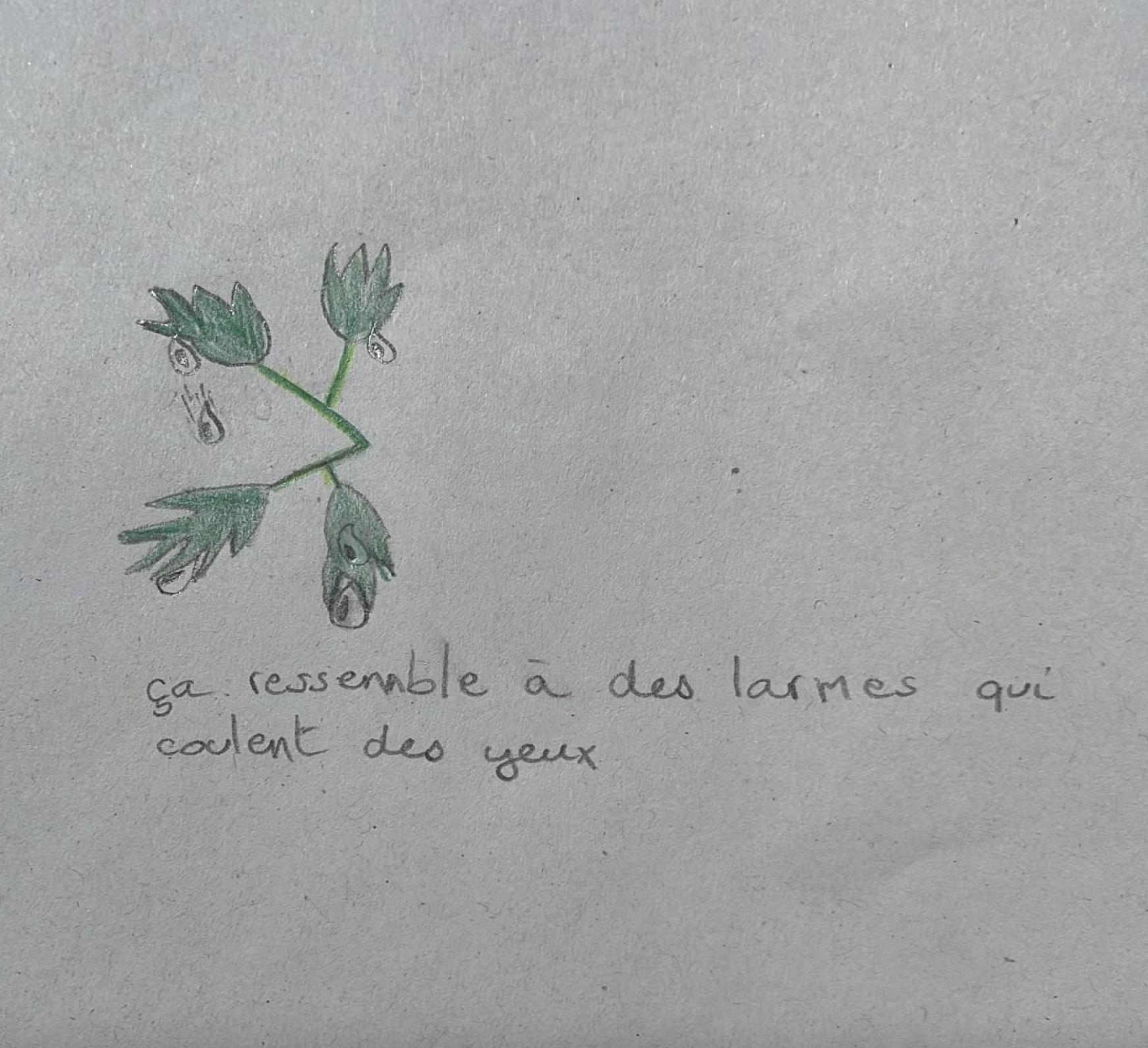
In the playground, we begin with a warm-up and create short choreographies that we offer to the environment surrounding each school—the mountain, the trees, the wind. We then propose a series of observation exercises. Tubes of different diameters and lengths are made available. Standing in the circle, we observe using different parts of the body: not only our eyes, but also our ears, our nose, even our shoulder. Once our senses have been awakened—and perhaps altered or sharpened through the use of the cylinders—we split into two groups. In the playground, as in the myth of P’an-ku, we search for similarities between our surroundings and our own bodies: What looks like your knee? Your eye? Your teeth? We begin to see roots, blades of grass, drain covers, and the sky in new ways. They become sad or joyful; they begin to resemble our skin and our hair.
We connect with the cylinders, either by touching them or by standing very close to them. We experiment with different rhythms together.
In class, we share these sensory observations. We explore our relationship to space, the body, and learning. What are the differences in sounds, smells, textures, and temperature between the inside of the classroom and the outdoor playground? How do we use our hands and feet at school? Do we close our eyes when we do math? Can we study French while sitting on the grass? Where do you feel comfortable at school? What would it be like to have school in your favorite place?
Workshop 2: Sensory Mapping / Body-Planet
Each workshop will then begin with a “body awareness exercise.” In the second workshop, we close our eyes, feel the roots of our feet, stretch our ears, eyes, and nose, awaken our limbs with a light rain, breathe in, shake ourselves out, and so on. This “body awareness” exercise always elicits a kind of laughter at first, caused by a body in the midst of transformation, social norms, sensations, and the fact of being in a circle and having to face one another.
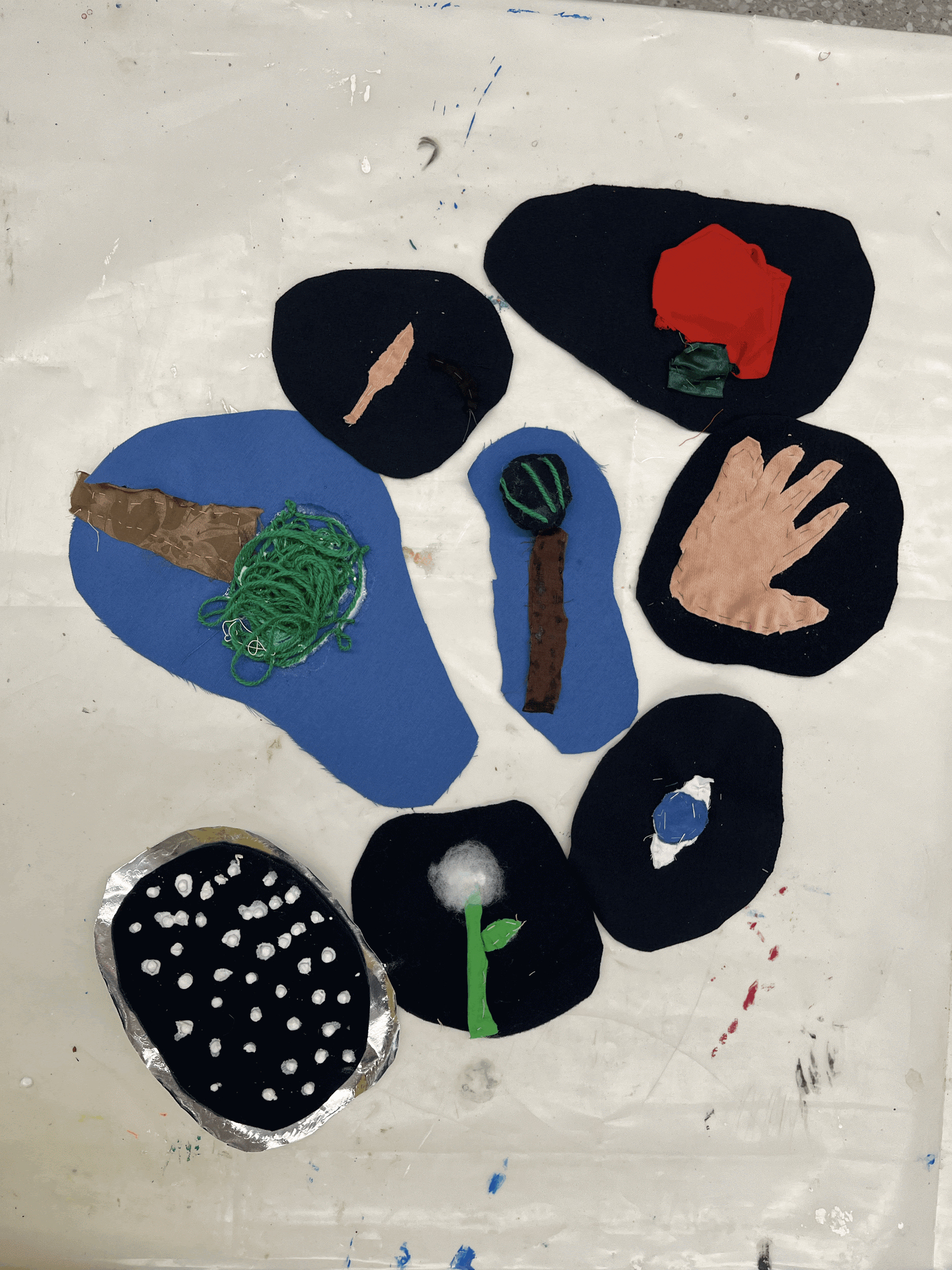
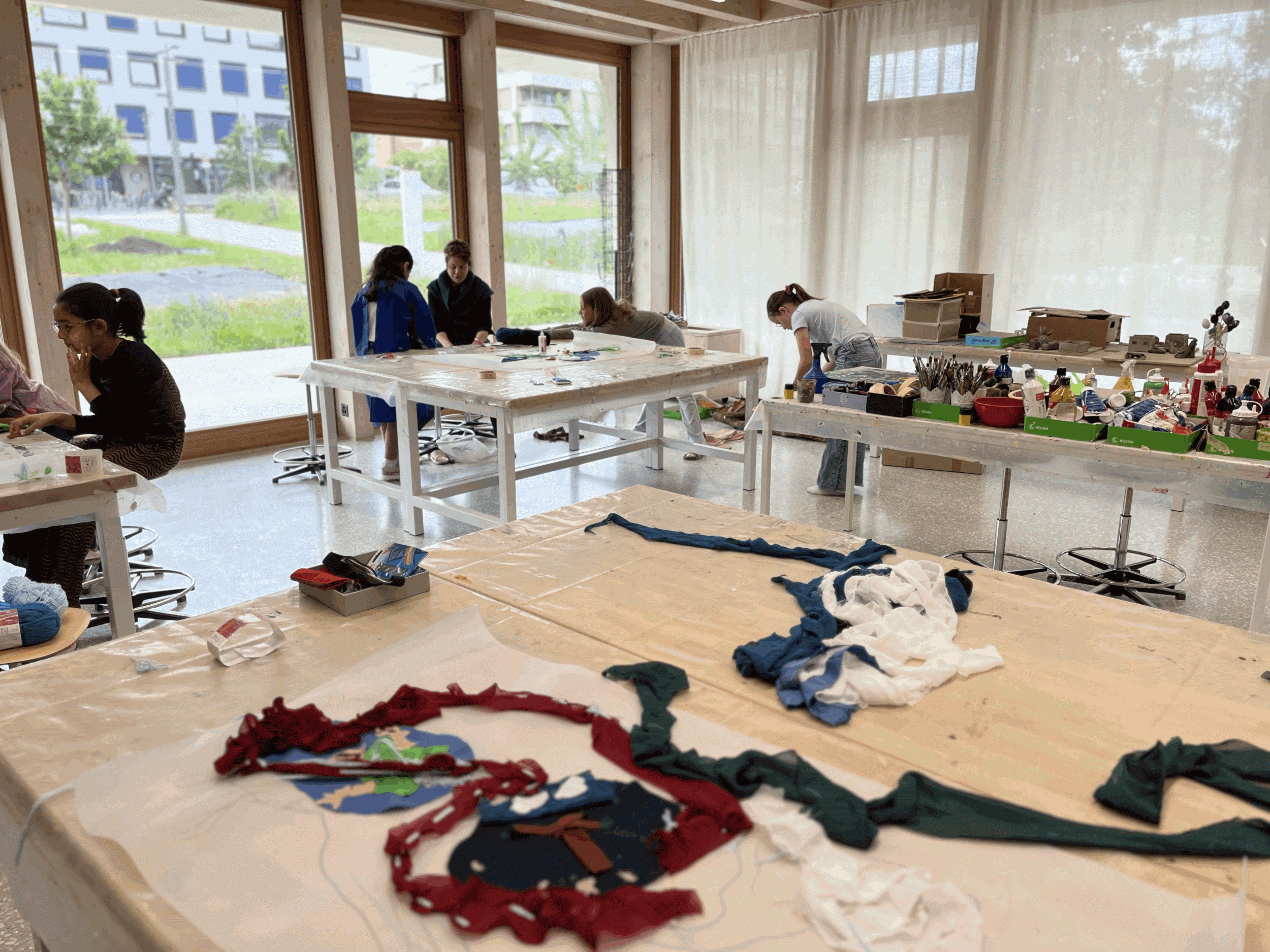
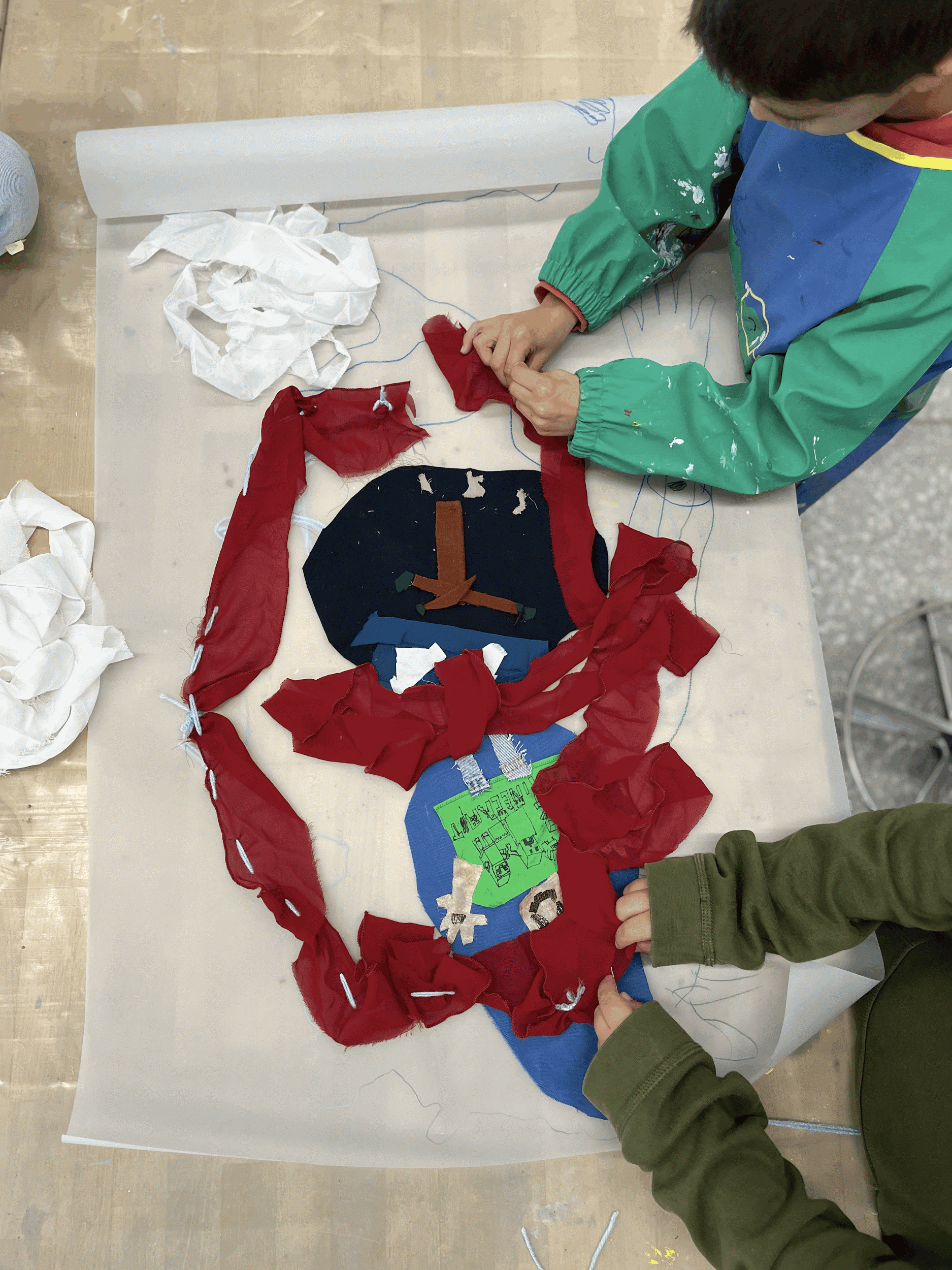
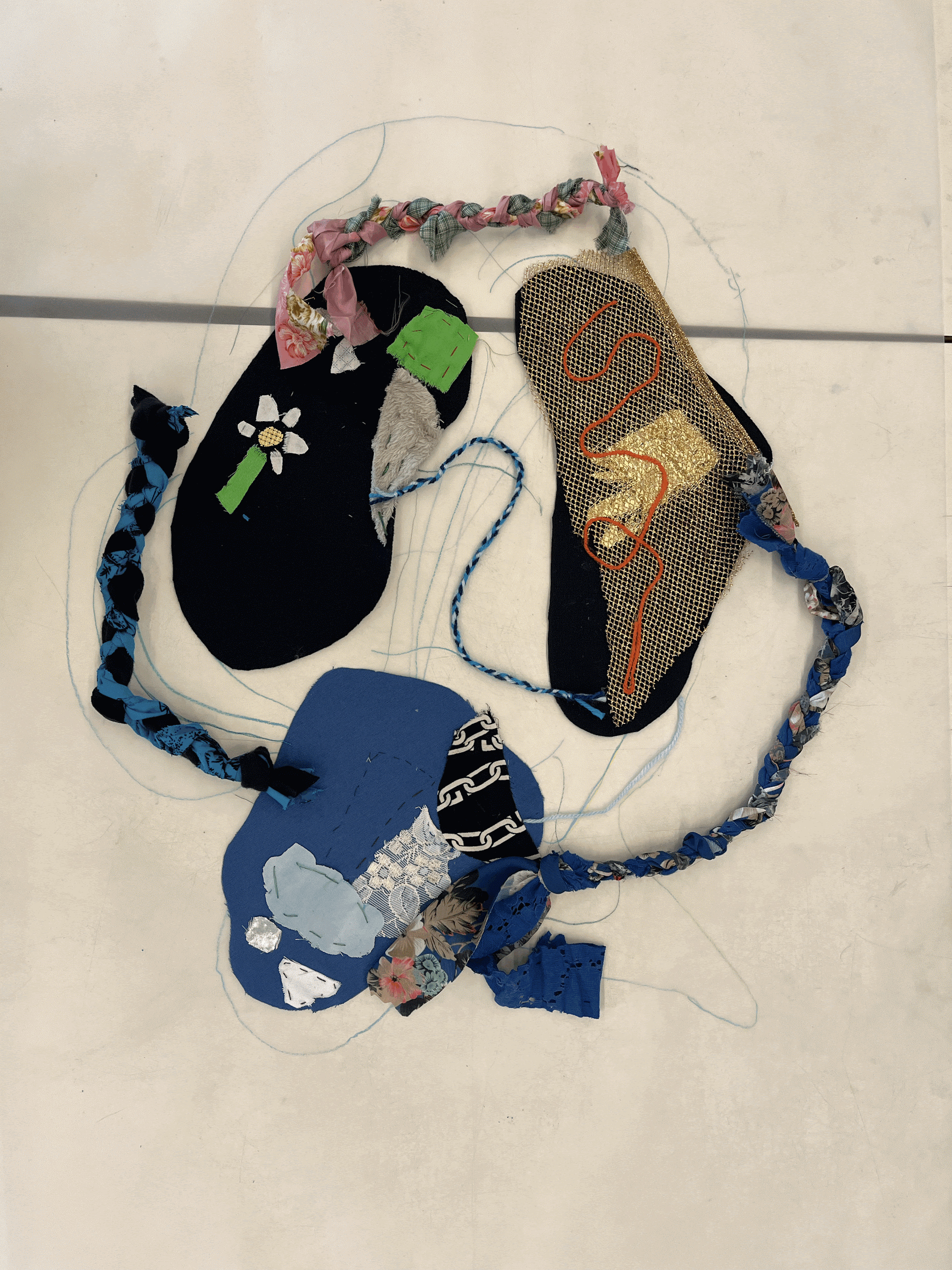
The second workshop is based on observations of the similarities between one’s body and space. Each student recalls and chooses an element and captures that memory in a drawing, which serves as a blueprint for creating a sensory memory that will be represented in fabric. This atlas brings together our versions of Pan’ku—the myth within our bodies and within the reality of school. From among the salvaged fabric scraps, students choose materials that evoke both body parts (skin, bones, muscles, etc.) and “natural” materials. The goal is abstraction, which is challenging. Learning to sew—something some students are reluctant to do at first—ultimately proves successful. They learn to appreciate the patience and concentration required by these meticulous gestures.
Workshop 3: Interconnections
We begin by awakening the different layers of the human body: becoming aware of our skin, contracting our muscles, and shaking our bones. We then drink a glass of water, paying attention to the path it takes through our organs, while also reflecting on the journey it has made before reaching us—from the tap, through pipes, the water treatment plant, into a river, the ocean, the clouds, the rain, or a glacier. It is the journey of water through the body of P’an-ku. But then, how many living beings have drunk this glass of water before us? And how many species inhabit our own bodies?
This third workshop focuses on connections: those that enable our own bodies to live, and those that allow the different bodies of the world to live together in a fragile balance. We form groups of three students and explore ways of connecting our artworks. The exercise is conceptual and somewhat challenging. To support the process, we trace the outline of a body onto large sheets of tracing paper. From this body, we compose a map of bodily memories. An anatomy book provides examples of arteries, bacteria, and the invisible density of the body. The water exercise encourages us to reflect on what connects the grass, the trees, and the rocks in the school playground. The students make links with the anatomy they have studied in science lessons and with geography classes where they learned about the formation of clouds.
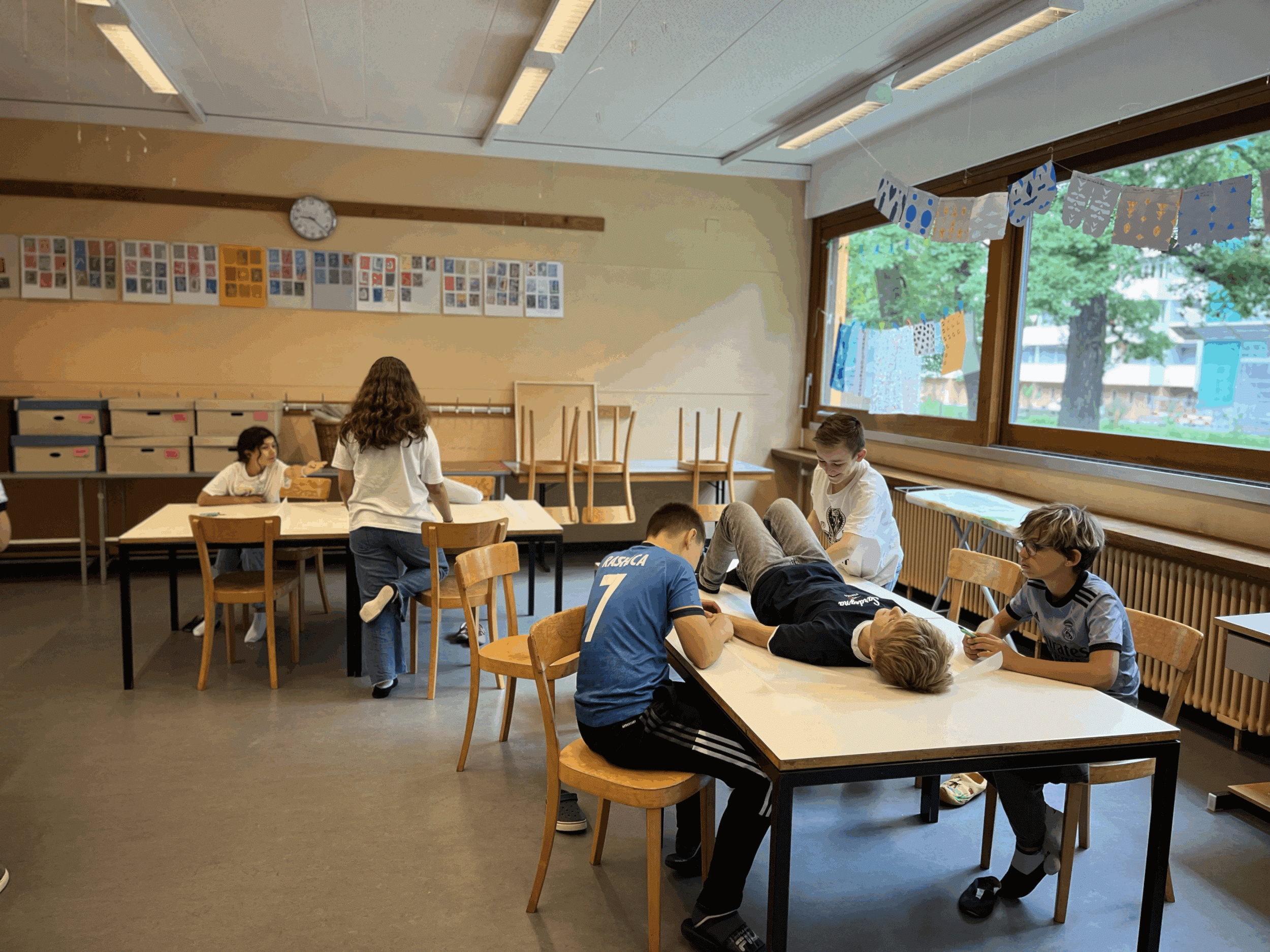
Following my example, we then begin weaving strands together to illustrate these connections and make them visible. These threads, linking our bodies to one another and to our memories of the environment, represent only a tiny fraction of the countless interconnections upon which life on Earth depends.
Workshop 4: with Fabian – The Food Chain
Fabian is introduced as an ecology specialist, which he describes as the study of living beings and their relationships with the environments in which they live.
In the gymnasium, we play a game designed to help us understand this concept. Before we begin moving, each student introduces themselves to Fabian by telling him about their favourite animal. We are struck by the remarkable diversity of living beings that emerges from this simple exercise.
The warm-up begins by embodying the qualities of the different living beings featured in the game: the rooted tree stretching towards the sky; the butterfly, light and airborne; the frog, leaping; and the fox, running close to the ground. The students are divided into four groups, each representing one of these living communities within a defined area representing an ecosystem, which also includes a lake and a flower. The trees are rooted in place—they cannot move—but they can provide shelter for the butterflies. The butterflies search for the flower to feed while avoiding the frogs. The frogs try to catch the butterflies while avoiding the foxes, and they may take refuge in the lake. The foxes attempt to catch the frogs. Once a player catches another or is caught, they sit down. When the ecosystem has completely collapsed, the roles are exchanged.
The aim of the game is not to produce winners or losers, but rather to observe how the ecosystem evolves over time. At the end of the four rounds, we sit together to refocus and each student writes anonymously about what they experienced while embodying a particular living being. After this moment of introspection, several of these reflections are read aloud without revealing their authors.
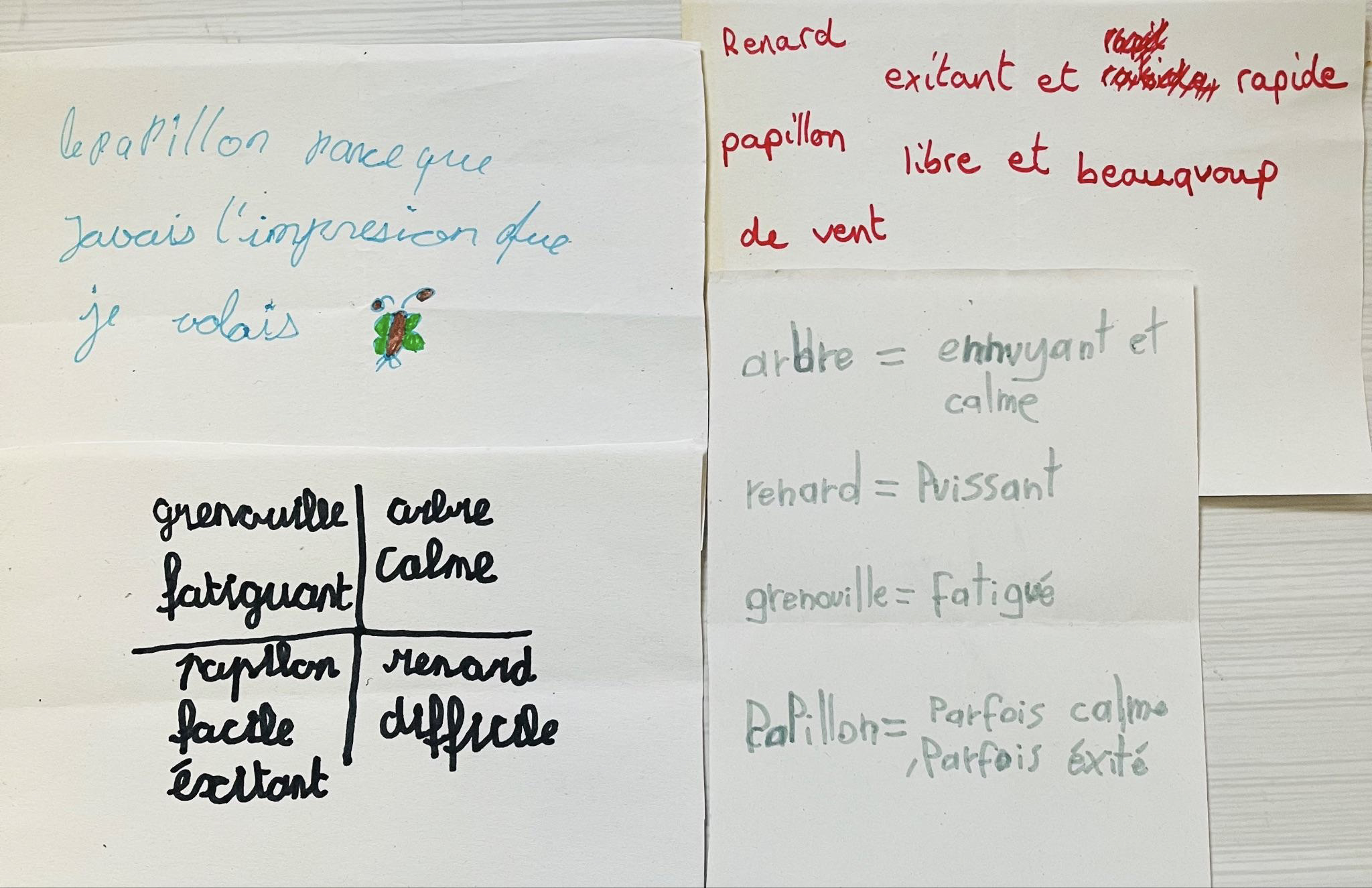
We open the discussion to the interdependence of species and the different senses used by each of them. Standing hand in hand, we connect all the species together, physically embodying the food chain. What happens if a human drinks all the water from the lake? The flower falls, then the butterfly, until eventually every species is lying on the ground.
We conclude with a discussion about the school's own ecosystem. What environments exist within the school? Which living beings share this space? How do you imagine their lives? How does it feel to attend school alongside them, to share the same environment? We gather in a storytelling circle, sharing encounters with the animals that inhabit the school: birds, spiders, shield bugs, bees, mice, rats, foxes, hedgehogs, and caterpillars. We hear stories of these animals living in the playground, finding their way into classrooms, using students' bodies as a means of transport, dying, or watching us from the toilets. Despite the richness of these stories, the idea of the school as a space shared with other living beings did not arise spontaneously among the children—even after spending the previous hour talking about and playing as animals. It required fairly guided questioning.
We finish by asking what kinds of environments the students would like to have within the school. Where would they like to learn? Very few non-urban environments are mentioned, but there is a wide variety of wishes: a cinema, a museum, a science room, a larger library, a school cooperative shop, a laser tag arena, a bowling alley, a games room, a cafeteria, or a biology classroom. Living and learning with others is still largely imagined as involving other humans, rather than other living beings. Fabian remarked:
"It isn't easy to ask children to invent at an age when they are constructing themselves by imitating those around them in order to integrate into their environment. And yet they possess endless imagination… A paradox!"
This game proved extremely popular. The students played it again at home and at school, sometimes adding new animals to the ecosystem. Many described it as one of their favourite activities and said they would like to play it again at school. The objectives of introducing the concepts of ecosystem and interdependence were successfully achieved, as the game enabled these ideas to be experienced physically while making them tangible through embodied learning.
Workshop 5: Weaving Through Space
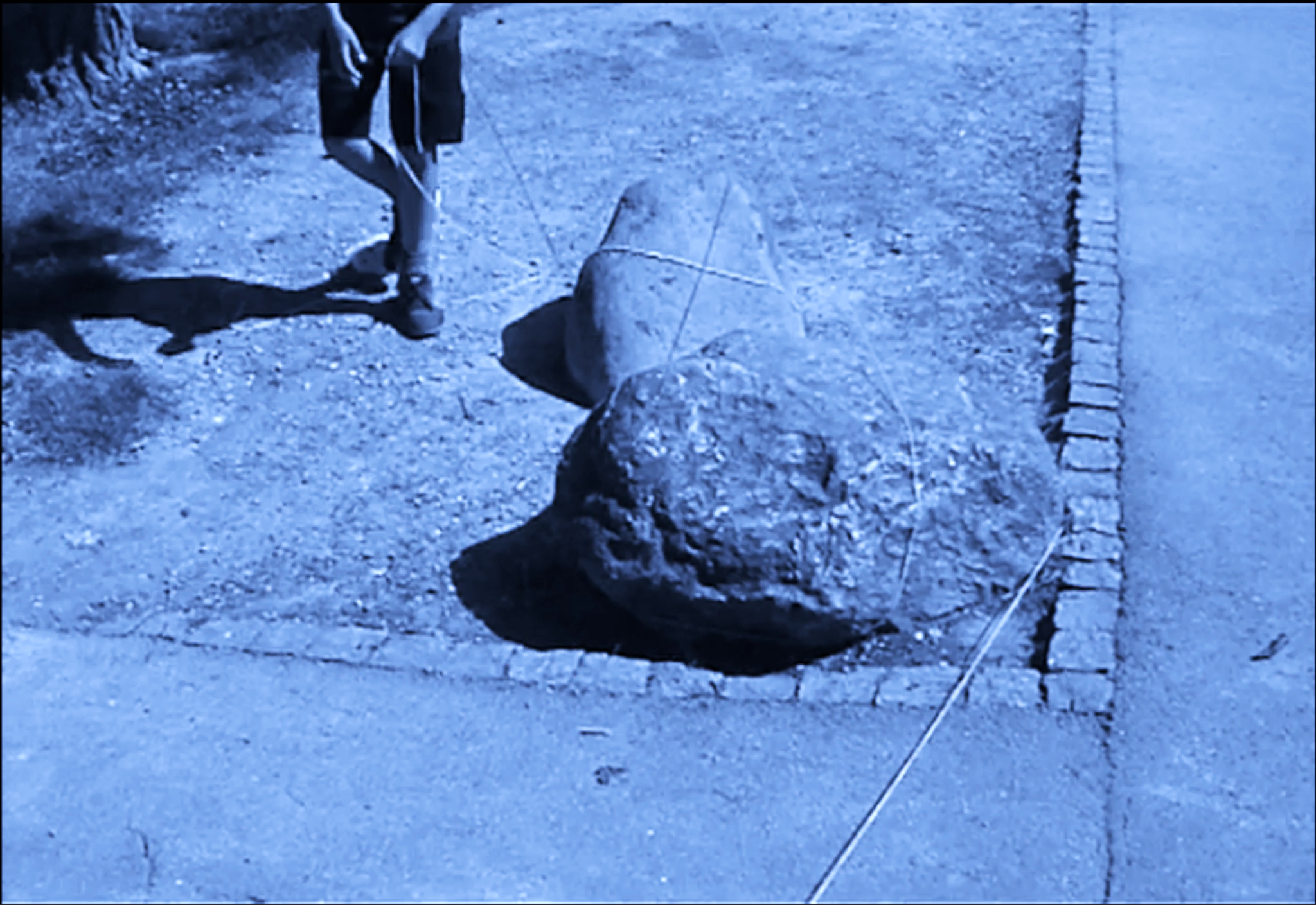
Once the sensory maps had been completed, and within each of the groups that had been formed, we returned to the playground to revisit the elements observed during the first workshop. Working in small groups, we explored the playground in search of "natural" elements and connected them together using balls of wool. This allowed us to physically trace the relationships between a tree, a rock, a flower, and other elements, while visually inhabiting the playground with these newly revealed interconnections. The activity transformed an abstract concept into a playful, embodied experience. It also became an excellent exercise for generating stories—or even myths—to inhabit the school environment.
With some groups, we reflected on the coexistence of living beings between these different elements. One group observed a spider weaving its web alongside our own woven threads. Perhaps it would even use one of our strands of wool... The students were invited to film this performance in order to preserve a record of these movement-based explorations, with the intention of sharing these experiences during the exhibition.
Workshop 6: Interviews
This ecopedagogical sequence concluded with a series of interviews, as part of a collective reflection on how to tell and transmit what we had experienced to others, within the framework of an exhibition. In small groups, I first conducted the interviews by asking the following questions: What do your artworks represent? What did you learn during the workshops? What did you like and dislike? The students then asked me their own questions, or asked questions among themselves.
Workshop 7: Exhibition Visit
The exhibition visit was a wonderful way to conclude the process. Bringing both classes to an art university (HEAD – Geneva) provided an excellent opportunity to discuss artistic professions and the possible pathways that can emerge from creative practices developed in the classroom.
The visit of the three projects (developed by Grace Gloria Denis, Aurélien Fontanet, and Lavinia Johnson) raised numerous questions ranging from food systems to melting glaciers, permaculture, myths, and various examples of social and environmental causes connected to the notion of ecopedagogy. This conception of the exhibition made it possible to integrate the students’ artworks into broader collective ecological reflections, and thus to situate an artistic practice developed within a school context within a body of works aimed at transformation.
ASSESSMENT
Due to the administrative delays required to obtain approval from the DIP, our different sequences had to be quickly adapted according to the remaining time and the schedules of the various teachers (end of the school year). This did not allow for an in-depth co-design of the workshops with general and specialised teachers. I had initially imagined that these workshops could be developed in parallel with their curriculum and personal objectives, but this would have required a significant amount of preparation time.
However, I had the opportunity to have numerous exchanges, feedback sessions, and shared reflections with the two visual arts teachers with whom I collaborated. This extremely enriching dialogue, both for me and for them, allowed me to observe that the experimental framework of the ecopedagogical processes I had imagined beforehand came into tension with several requirements of the DIP (administrative aspects, organisation, distance between encounters with students, school spaces, curricula, etc.).
In the future, I will simplify the concept addressed with students and focus on a more condensed sequence over time, with a form of final outcome established in advance. This will make it possible to decide together with the students on aspects related to the final exhibition, which I this time designed with the support of the artist Barbara Mermoud. This shared objective (even if it will evolve through co-creation) will also allow for a clearer initial dialogue with the school, teachers, and students.
I note that the use of school spaces by external contributors such as Fabian and Valeska was extremely enriching for rethinking these places, movements within them, and the compartmentalised separation of school subjects.
Throughout the workshops, I was delighted to see that the central idea of my intervention—that ecology is based on the interconnection of living beings—was integrated by the students. The interviews confirmed that they had made the concept their own, through their imagination and their interpretation of the workshops we experienced together. The visual arts teachers shared with me that they intended to reuse certain aspects of the project, particularly the body-awareness ritual and the myth of P’an-ku.
BIBLIOGRAPHIC REFERENCES:
- Aït-Touati, Frédérique et al. Terra forma : manuel de cartographies potentielles. Deuxième édition. Montreuil: Editions B42, 2023. Print.
- Akram Khan Company. Moving Stories -The Teacher Training Programme. https://www.akramkhancompany.net/productions/teacher-training-programme/
- Andrieu, Bernard. Philosophie du corps : expériences, interactions et écologie corporelle. Paris: J. Vrin, 2010. Print.Bigé, Emma. Mouvementements : écopolitiques de la danse. 1st ed. Paris: La Découverte, 2023. Print.
- Caroline Pham. Contre-Cartographie. Ceci n’est Pas Un Atlas. Ouvrage et Exposition. GéoRéseau, 2023. Print.
- Derk Bodde, Dorothy Borei, and Charles Le Blanc. “Myths of Ancient China (1961).” Essays on Chinese Civilization. Princeton University Press, 2014. Print.
- Curnier, Daniel. Vers une école éco-logique. Lormont: Le Bord de l’eau, 2021. Print.
- Dell, Christopher. Mythology: The Complete Guide to Our Imagined Worlds. New York:Thames & Hudson, 2012, p. 90. ISBN 978-0-500-51615-7.
- d’Huy, Julien. Cosmogonies : La Préhistoire des mythes. Paris (9bis, rue Abel Hovelacque 75013): La Découverte, 2020. Print.
- Le Blanc, Charles et al. Approches critiques de la mythologie chinoise. 1re éd. Montréal [Que.]: Presses de l’Université de Montréal, 2007. Web. https://doi.org/10.4000/books.pum.19027.
- Lesage, Benoît. La danse dans le processus thérapeutique : fondements, outils et clinique en danse-thérapie. Ramonville Saint-Agne: Erès, 2006. Print.
- Maspero, H. « Légendes mythologiques dans le Chou king ». Journal Asiatique 1941-1995 204 (1924): 1-. Print.
- Mathieu, Rémi. « Une création du monde ». Presses de l’Université de Montréal, 1992. Web. https://doi.org/10.4000/books.pum.15997.
- Otte, Jean-Pierre. « Les mythes de la création : les matins du monde : du Cercle polaire à l’Océanie ». Paris: Les Belles lettres, 2017. Print.
- San Pedro, Marcela, et Noemi Lapzeson. Un corps qui pense : Noemi Lapzeson : transmettre en danse contemporaine. Erscheinungsort nicht ermittelbar: MétisPresses, 2014. Print.
- Sen, Amartya Kumar. Development as Freedom. 17th printing. Oxford: Oxford University Press, 2001. Print.
CONTRIBUTION TO AN ECOPEDAGOGICAL TOOLKIT
CONTRIBUTION TO AN ECOPEDAGOGICAL TOOLKIT
EXPERIMENTING WITH YOUR BODY–PLANET
Some ideas for sensory experiences that allow students to embody the concepts of a creative ecology at school.
With which parts of the body can we observe the world? With two eyes, one eye? With our elbows? Our ears? Our nose?
While observing the playground, can I find elements that resemble my body, my eyes, my hair, my knees, my teeth? What connects these different elements within my body? And what connects them in the playground/nature?
Use the five senses in the playground, then in the classroom: what differences do you perceive? What are the sounds like? What sensations do we feel on our skin?
What happens if I become a tree, if my feet take root in the ground and my arms stretch towards the sky? How do I perceive the world from this perspective? And what about being a butterfly, a frog, or a fox?
How do the different living beings in the school coexist? What are the perspectives of insects, animals, and plants? For example, what is the spider’s point of view in the mathematics classroom? Do butterflies have enough flowers in the playground?
-
- Also translated as “Pangu.” The written records of this myth appear to date back to Xu Zheng, a statesman of the Kingdom of Wu during the Three Kingdoms period (3rd century). The earliest pictorial representation is estimated to date from 194 CE and is believed to have originated among the Eastern Han in Sichuan (near Tibet), the region from which Xu Zheng came (Mathieu, R. (1992). Une création du monde. Presses de l’Université de Montréal). Due to their oral tradition, myths transform over time, according to historical periods, geographical contexts, and processes of translation. Here, I use a simplified version compiled from various translations.