The Contradictions of Environmental Technocapitalism and Its Opponents. A Philosophical Education Investigation into the Future
Irène Pereira, Professeure des Universités, Rouen-Normandie CIRNEF/Université, 2025
The prospective article published below was commissioned from Irène Pereira following our reading of her book ÉCOPÉDAGOGIE. Éduquer à la justice sociale et écologique. Une introduction (Ecopedagogy: Educating for Social and Ecological Justice. An Introduction), a work that, in our view, represents an important moment in the reception of the notion of ecopedagogy within the French-speaking context.The book brings together, in a single volume, references that had previously been dispersed, offers a clear mapping of contemporary debates, and provides a shared vocabulary for thinking about the relationships between education, ecology, and social justice.In it, the author provides an accessible synthesis of this field, inherited from Paulo Freire’s critical pedagogy and developed primarily in Latin America. She argues that ecological issues cannot be understood independently from the social relations that produce them. Rather than reducing environmental education to learning “good behaviours” or adopting individual eco-actions, Pereira demonstrates that ecological crises are also questions of social justice, power, and inequality.The book first traces the way in which environmental concerns have progressively emerged as a public issue at the international level, before examining the limitations of dominant approaches to education for sustainable development. According to the author, these approaches tend to individualise responsibility and to remove the political dimensions of ecological transition. Drawing on research concerning environmental inequalities, environmental justice, and the notion of a “just transition,” Pereira instead proposes an approach that systematically connects ecological justice and social justice.A significant part of the book is devoted to clarifying the different strands of critical environmental education. Pereira identifies, in particular, eco-humanist approaches, critical posthumanist approaches, and eco-social currents, among which she situates ecopedagogy. The latter is presented as a dialogical and problem-posing pedagogy (following the Freirean tradition), inviting learners to question relations of domination, socio-environmental conflicts, and collective choices about society, rather than simply applying prescribed behavioural guidelines.The second part of the book translates these principles into concrete pedagogical proposals, structured around questions such as: Who suffers? Who benefits? What forms of effort are required? And what kind of ecological society do we wish to build?Although the book does not directly address the role that art can play in ecopedagogical processes, it is particularly stimulating for artists interested in questions at the intersection of ecology, pedagogy, and socially engaged artistic practices. The principles of ecopedagogy—problematizing situations, fostering dialogue, paying attention to socio-environmental conflicts, and connecting critique with social transformation—provide a valuable framework for rethinking the relationships between artistic creation, learning, and social or ecological engagement. microsillons, 2026
I. METHODOLOGICAL FRAMEWORK OF THE RESEARCH
1. Research Question
Research question:
What types of existential formation emerge from imaginaries of the future?
The term “existential formation” can be understood as a process through which individuals acquire a particular representation of themselves, of existence, of the world, and of the meaning of their existence within the world.
Religions and philosophies offer different conceptions of existential formation. Two types of existential formation can be distinguished:
– Self-existential formation: a process carried out by the individual themselves.
– Hetero-existential formation: a process linked to the socialisation produced by a given type of social organisation.
Imaginaries of the future, through the visions of the future they propose, imply different conceptions of existential formation.
2. Presentation of the fictional field:
Environmental Technocapitalism as a Possible Future
Why choose eco-technocapitalism as a fictional field of investigation?
As Agnès Zevaco demonstrates in Voyage au centre de la Tech (2018), there is a connection between science-fiction imaginaries and the imaginaries developed by actors within the technology industry.
We hypothesise that one of the dominant imaginaries among economic and technological elites is eco-technocapitalism. This imaginary is based on faith in market economics and technological innovation as solutions to all the problems humanity may face.
It is embodied, among others, in two ideological currents: eco-modernism and transhumanism.
The construction of this possible technocapitalist world draws upon elements from theoretical literature concerning contemporary technocapitalism.
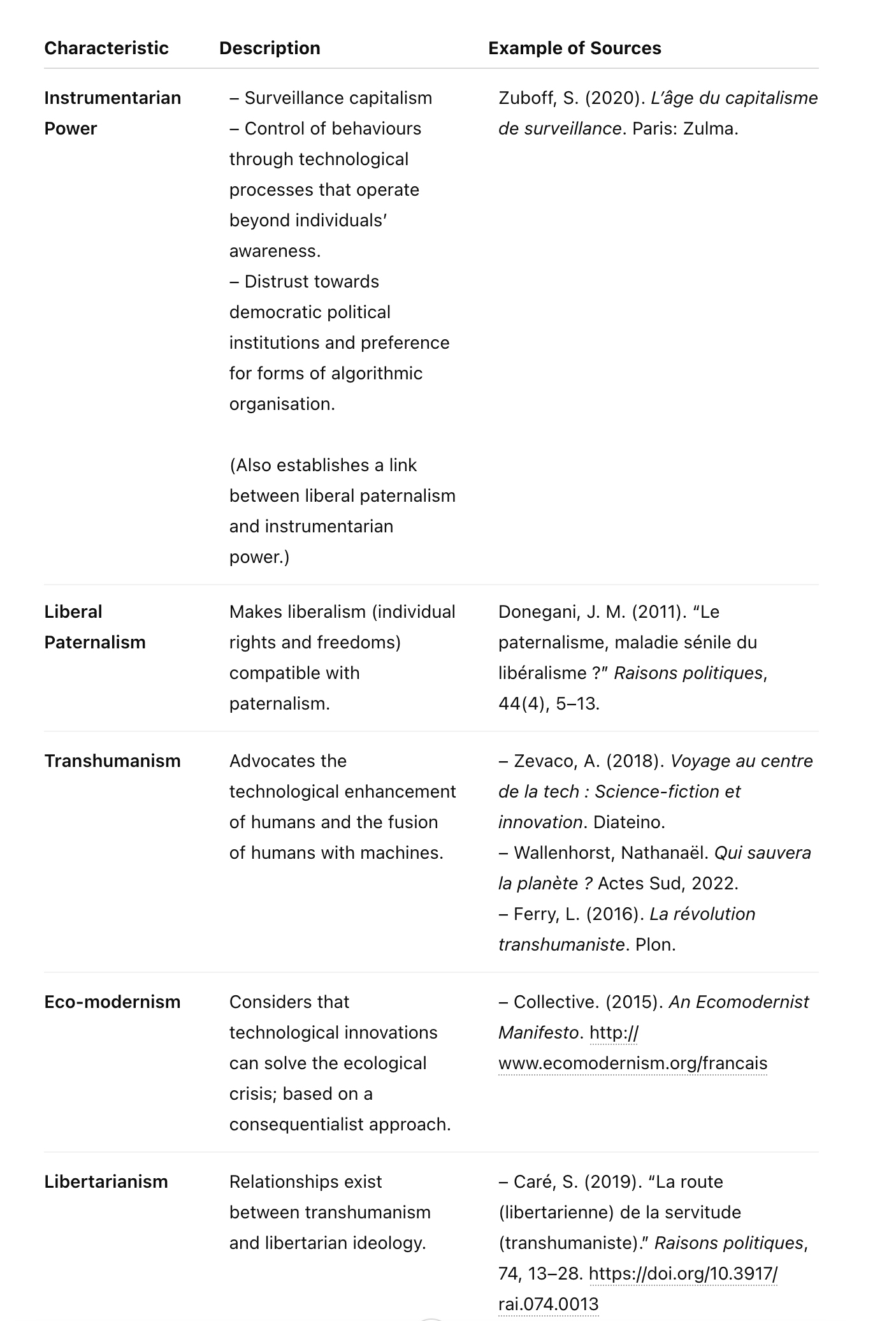
3. Construction of the characters in the investigation
The characters in the investigation are constructed from philosophical positions that exist within contemporary theoretical literature.
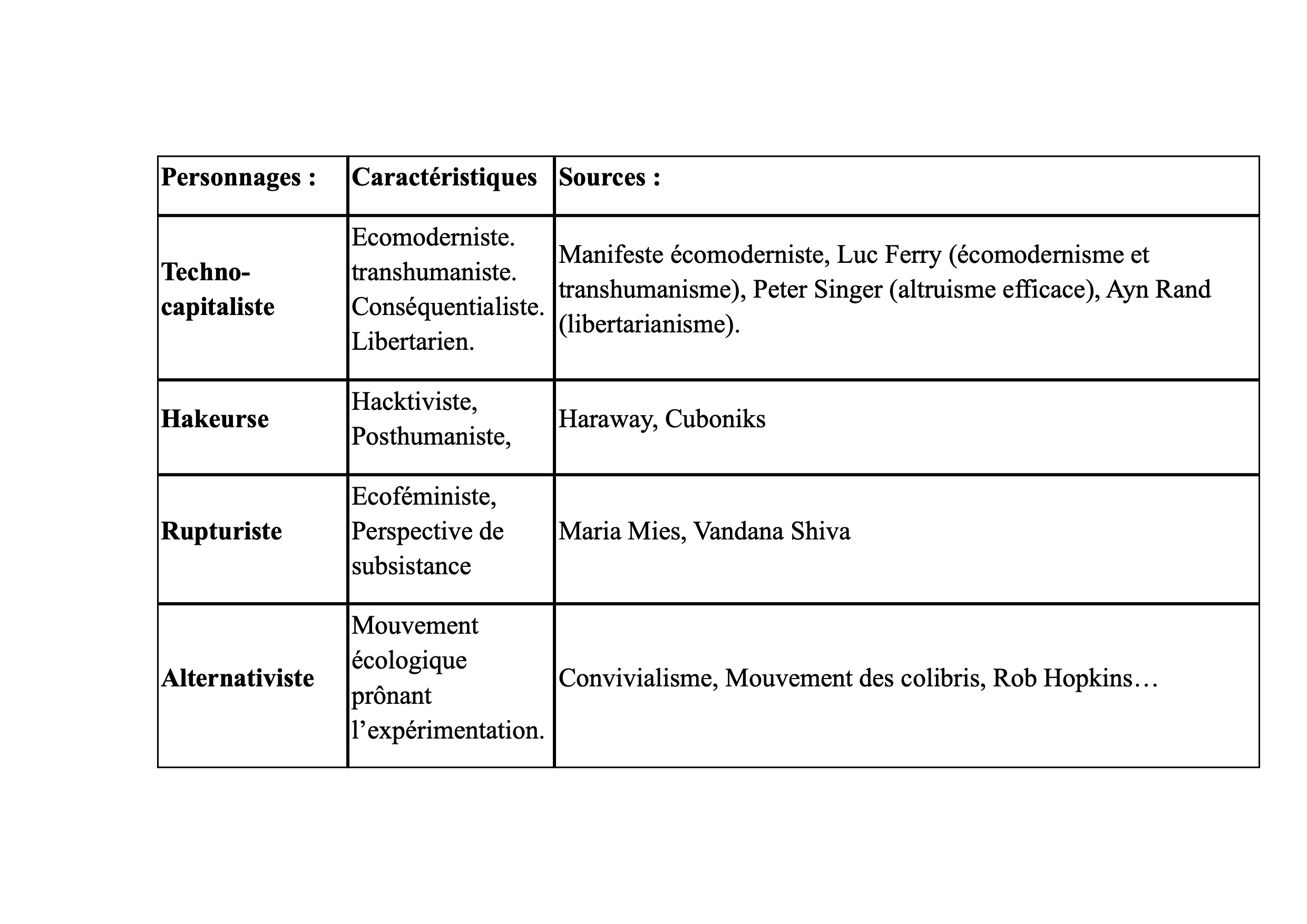
4. Hypotheses
Hypothesis 1.1:
A technocapitalist way of life corresponds to specific forms of existential formation.
Hypothesis 1.2:
Technocapitalist life is situated between different conceptions of existential formation.
Two models of existential formation appear to exist within technocapitalist life:
– A libertarian model emphasises the existence of fundamental freedoms and advocates radical non-paternalism.
– A utilitarian model accepts that collective decision-making can be oriented according to common utility and collective well-being.
The research will seek to highlight these contradictions.
Hypothesis 2.1:
Opponents of technocapitalism also propose alternative forms of existential formation to technocapitalism.
Hypothesis 2.2:
Here again, we hypothesise that the conceptions of existential formation proposed by opponents of technocapitalism are themselves marked by internal contradictions.
5. Research Method: “Fictional Field Philosophy” (Pereira, 2024)
The dialogical framework consists of imagining dialogues between three types of protagonists:
a) An Apprentice Philosopher (AP), whose role is to raise sceptical questions and problematise assumptions.
b) A supporter of eco-technocapitalism (TC).
c) An opponent of this proposed trajectory for the world.
II. PRESENTATION OF THE RESULTS
Below, we present a sample of the fictional interviews that were conducted (Pereira, 2023).
Interview with TC, Designer at TechnoFutur
(Regarding the opponents of TechnoFutur)
AP (doctoral student in philosophy):
— What do you think about the people who are radically opposed to TechnoFutur’s vision?
TC:
— First of all, these people are often divided in their strategies. It is all very well to oppose technocapitalism, but there are not many people who are willing to give up their own comfort in order to join the “rupturists” and live according to their principles of a subsistence economy.
AP:
— Perhaps one could choose a less radical approach, such as that of the alternativists, and develop low-tech solutions, “convivial tools” (Illich).
TC:
— Listen, alternativists are not capable of demonstrating that their experiments are valid on a global scale. They remain highly localised experiments.
AP:
— But are there not valid criticisms among those directed at you?
TC:
— We must first understand that the only viable economic system is capitalism. Furthermore, only liberal democracies have so far been able to guarantee individual rights. No alternative system has succeeded in establishing itself. We can take the example of the collapse of the Soviet bloc.
AP:
— Yet your opponents accuse technocapitalism of leading to a society that restricts freedom by imposing constant collection of personal data in the name of “liberal paternalism.”
TC:
— As you say, this is not coercive paternalism, but incentive-based paternalism. From this perspective, we do not consider it to be an infringement on freedom.
AP:
— But some of the technologies you use bypass individuals’ conscious awareness in order to induce certain actions.
TC:
— Nevertheless, people are informed before using our technologies that they will receive positive incentives. They must also tick a box confirming this.
AP:
— But in exchange for their consent, you offer them the possibility of using your services for free.
TC:
— As you said, there must be an exchange. These technologies cost us money in research and development. No one is forced to use them. If people do not wish to use any of our technologies, they can always join the “rupturists.”
AP:
— Nevertheless, technocapitalism has not eliminated inequalities of wealth.
TC:
— We do not claim to eliminate inequalities of wealth, but rather to increase collective well-being. As philosopher Peter Singer has highlighted, poverty is a problem. We intend to eradicate it precisely through technology and the market economy. The same applies to other human problems such as disease, ageing, and death.
AP:
— But this has not yet happened…
TC:
— We have not yet succeeded in developing the necessary technologies, but we are getting closer each time. Regarding technology, there may certainly be harmful short-term effects, but each harmful effect will gradually be corrected. We have not yet found a perfect solution to ecological problems, but we have made progress in that direction.
Interview with an Alternativist, Opponent of TechnoFutur
AP (doctoral student in philosophy):
— Could you explain what is meant by alternativism?
A (supporter of alternativism):
— Alternativists are people who defend the idea that the dominant, even hegemonic, worldview promoted by TechnoFutur can be challenged through the development of experiments in the form of alternatives.
Generally speaking, alternativists share several common characteristics. They support the development of “low-tech” and convivial tools that can provide alternatives to technocapitalist technological innovations.
Alternativists also support the development of experiments in the social and solidarity economy that can provide alternatives to capitalism. They generally advocate participatory democratic practices as well. They experiment with alternative ways of living.
However, within this perspective, two approaches can be distinguished. The first considers that alternatives can gradually spread and eventually enable the emergence of a socio-economic system alternative to technocapitalism.
There are also those who believe that alternatives cannot completely transform the current social system—or who do not necessarily wish to do so—but who think that they can contribute to making it better and more humane.
AP:
— In what ways do you oppose TechnoFutur?
A:
— First, our opposition to TechnoFutur concerns the lifestyles and the utilitarian philosophy that guide its proposals.
We seek to live differently by placing human relationships at the centre. This is why we favour a solidarity-based economy and face-to-face democracy.
Technology should serve humanity, not dominate it. Political organisation should serve humanity, not enslave it. The economy should serve humanity and not be oriented towards an endless accumulation of wealth.
We want to place human beings back at the centre of the social system, which no longer seems to be the case today.
AP:
— Your opposition to TechnoFutur seems more accessible to ordinary people than, for example, that of the hacktivists who live underground or the rupturists who advocate a subsistence economy.
You advocate a simple life, but not an austere or ascetic one. How do you explain the fact that you have not managed to convince more people?
Your critics argue that your initiatives are often viable only on a local scale and are unable to offer alternatives at a broader level.
They argue that even when one of your ideas manages to spread, at best it only feeds the machine without truly transforming it. Your technical innovations are taken up again in order to generate new profits.
A:
— Our difficulty comes, among other things, from the fact that we do not have the same resources as TechnoFutur to disseminate our experiments. They remain largely unknown to the general public.
AP:
— But even when people see the experiments you carry out, they do not necessarily change their lives and join your alternatives. How do you explain this?
A:
— Most people are caught within a whole set of relationships that function as a system of technocapitalist control: work, purchasing a home, mass consumption, entertainment industries… They are tied to this entire system and cannot simply leave it.
Liberal economists tell us that consumers act as rational agents. However, these agents are embedded within a set of economic and technological relationships that deprive them of genuine freedom of choice.
AP:
— How do you intend to challenge what you describe as a “system of control”?
A:
— I will not hide the fact that this is where we encounter difficulties. We do not manage to globally transform ways of life. Sometimes, as you mentioned, one of our innovations spreads beyond our own circles. But for the most part, the behaviours we hoped to change remain unchanged.
Interview with a Hacktivist, Opponent of TechnoFutur
AP (doctoral student in philosophy):
— It was not easy to arrange this meeting. You asked me to communicate through an encrypted channel. Could you explain what opposition to TechnoFutur means for hacktivists?
H (member of the clandestine Hacktivist movement):
— We carry out cyberattacks against TechnoFutur’s innovations. In particular, we launch sabotage raids against their simulators. We also use their technologies in order to subvert them.
AP:
— But does this not constitute a limitation of your strategy? In a way, you depend on TechnoFutur, since your methods rely on diverting technologies produced by TechnoFutur.
H:
— This is not entirely true. We also produce “low-tech” technologies that we develop ourselves. The aim is to achieve technological autonomy. These technologies can be manufactured and repaired by ourselves. They are “convivial tools” (to use Illich’s terminology).
AP:
— But you are not completely independent from TechnoFutur technologically, for example regarding certain basic components.
H:
— That is true, but it is only a matter of time.
AP:
— You support post-sexualism like TechnoFutur. How do your positions nevertheless differ?
H:
— We want people to be autonomous in their bodily transformations and not dependent on the power of multinational corporations affiliated with TechnoFutur. As you know, many multinational corporations finance TechnoFutur, which in return provides them with new technological innovation ideas through its simulators.
AP:
— TechnoFutur also supports anti-speciesism. Here again, these are ideas you defend. Where does your opposition lie?
H:
— We do not need laboratory-grown meat to defend anti-speciesism. These are unrelated issues. One can simply be vegan.
AP:
— Another point: you advocate human/machine hybridisation (cyborgs) and human/animal hybridisation (chimeras). Again, these are orientations defended by TechnoFutur. Can you explain the difference between your approaches?
H:
— We believe that human beings can reconstruct reality through technology and should not allow themselves to be limited by moral norms, whether these norms claim to be based on religion, social conventions, or nature.
The main point of divergence does not concern techno-constructivism itself, but rather the economic power relations implied by TechnoFutur.
Indeed, they patent their technologies and lock their source codes so that everyone cannot use them.
We are libertarians. We believe that everyone should be able to use whatever technologies they wish in order to transform themselves. There should be no limit to this. It is even an ethics and an aesthetics of life.
The problem is that the multinational corporations affiliated with TechnoFutur claim control over access to these technologies in exchange for financial payment. We oppose TechnoFutur’s capitalist logic.
For us, everyone should have access to these technologies, without restrictions and free of charge.
AP:
— But is there not a risk of exceeding the ecological limits of the planet through unlimited use of these technologies?
H:
— We support technologies that do not harm the Earth.
AP:
— But is there not a contradiction here, since at the same time you consider that technologies can overcome all so-called “natural” limits, such as those between animals and humans, humans and machines, and men and women?
H:
— Let us say that we are wary of any notion of limits, especially when these limits are presented as natural. Being opposed to ecological disasters does not necessarily mean respecting so-called natural limits.
AP:
— This means that you believe what are usually described as natural limits can be overcome through green technologies—that is, technologies that do not degrade the environment.
H:
— Yes, that is one way of putting it.
Interview with an ecofeminist rupturist opposing TechnoFutur
AP (Philosophy PhD student): To meet you, one has to go beyond the zone of influence of the governance AI, into an autonomous zone. How do you explain your access to autonomous zones?
EF: – Technocapitalists seek to maintain the appearance of liberalism. They never officially resort to coercion. Moreover, when it comes to alternativists, they are willing to appropriate their innovations if they can integrate them into the technocapitalist system in order to make money.
AP: You have developed a way of life based on a subsistence economy. You are strongly influenced by the ecofeminist current of the subsistence perspective, whose pioneers include Maria Mies and Vandana Shiva. How do you explain the fact that you nevertheless fail to convince a wider population to adopt your way of life?
EF: As Maria Mies and Aurélien Berlan have shown, liberalism is based on the idea of freedom as liberation from constraints, whereas the subsistence perspective is based on the idea of freedom as autonomy.
Technocapitalists enclose people within a “techno-cocoon” (Alain Damasio). As a result, it becomes difficult for anyone to escape this techno-cocoon and join a world that is free but austere. You know, it is like in Ursula Le Guin’s The Dispossessed: we are free, but our way of life is austere.
AP: There is also a questionable aspect of the way of life you have adopted: the domestic mode of production (or subsistence economy) seems to imply a highly unequal gendered division of labour. One might fear that in autonomous zones, without household appliances, it is women who would bear an even greater share of domestic tasks.
EF: I will not hide it from you: we must constantly struggle internally, among ourselves, to establish an equal distribution of domestic tasks.
AP: You claim to be libertarian. Does this not lead to forms of coercive organisation?
EF: Rather than libertarian, I would say that we are advocates of radical democracy and self-organisation. But everyone must abide by the collective decisions that have been made. We are not extreme individualists.
AP: But does this not lead to a tyranny of the majority?
EF: We try to ensure that decisions are made through consensus. We give a great deal of importance to collective discussion.
AP: Another question concerns your position regarding the post-sexualism defended by TechnoFutur. Does your rejection of technological innovations not conflict with LGBTQI+ claims regarding gender diversity?
EF: We consider that what constitutes gender does not come from technological interventions, but rather from a social reality. For us, social transition is more important than the use of biological technologies to modify the body.
AP: You know that this position is exclusionary towards some LGBTQI+ people who might want to join you.
EF: Yes, this is a problem. But they can join the Hakeurses, who are also pursuing autonomous approaches. Moreover, we tolerate the presence of certain autonomous technologies originating from Hakeurses communities. But, let us say that we still place greater value on the symbolic and social dimensions of defining gender than on biological transformations.
AP: Do you welcome cyborgs or humanoids opposed to technocapitalism into your autonomous zone?
EF: This is a recurring subject of discussion among us. But for the moment, we prefer that they join Hakeurses communities.
AP: Another question I had concerns animal liberation. You know that TechnoFutur is anti-speciesist. How do you position yourselves in relation to this issue?
EF: We consider that the problem is not animal husbandry, which has always existed in subsistence economies, but rather animal production, which originates from the industrialisation of agriculture. On this point, we feel closer to Jocelyn Porcher than to Peter Singer.
III. DISCUSSION – CONTRADICTIONS
The fictional interviews between the different protagonists reveal contradictions, either between different currents or even within a single current.
Eco-technocapitalists: They adhere to political, economic and cultural liberalism. However, they are caught between the idea of considering individuals as free (by respecting fundamental rights such as privacy and presupposing autonomy of will) and the tendency to orient behaviours in a liberal manner (“liberal paternalism”, positive incentives, etc.) through technologies according to capitalist imperatives.
Alternativists: They consider that the system can be substantially transformed through alternatives. However, they struggle to expand these alternatives. And when they do expand them, it seems that these alternatives end up feeding the capitalist machine.
Rupturists (ecofeminists, anti-industrial movements, etc.): They advocate a return to a subsistence economy. In doing so, they believe they can face collapse. Nevertheless, they struggle to take queer claims into account. They also do not have a clear position regarding the status to be granted to other living species.
Hakeurses: They develop an opposition to the technocapitalist world, but remain ambiguous regarding technocapitalist technologies. They oscillate between a strategy of subverting these technologies and a strategy of achieving autonomy from them.
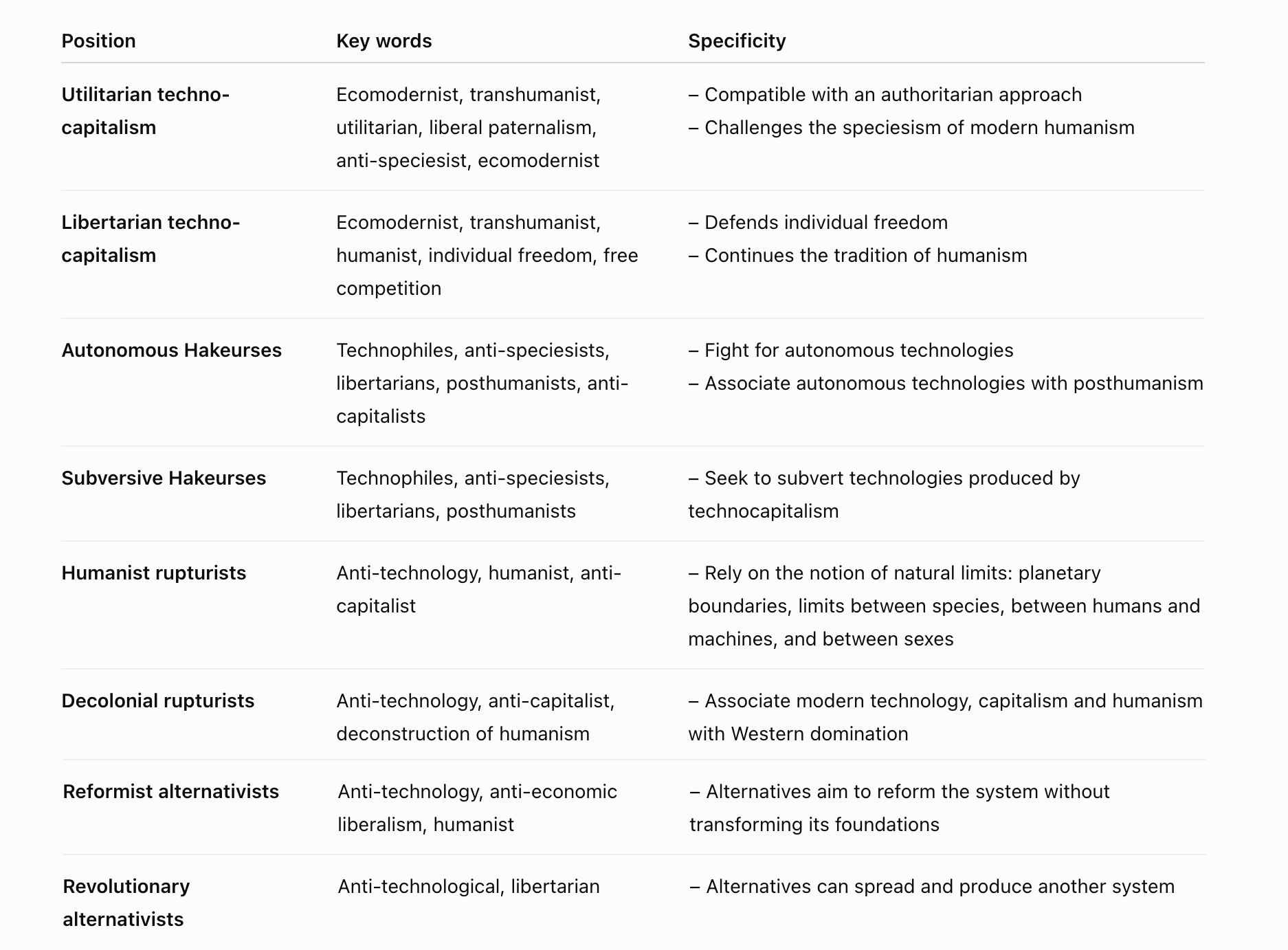
Synthesis table of positions:
The positions are not straightforward and prove to be internally divided. Each position corresponds to a different type of existential formation.
Bibliography:
- Pereira I. (2023). Education philosophique au futur. - https://ssophor8.wordpress.com/
- Pereira, I. (2024). Écopédagogie : Éduquer à la justice sociale et écologique, une introduction. Academia.
- Zevaco, A. (2018). Voyage au centre de la tech : Science-fiction et innovation. Diateino.